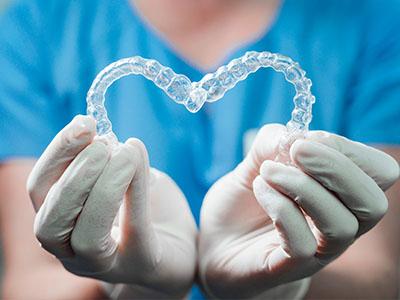
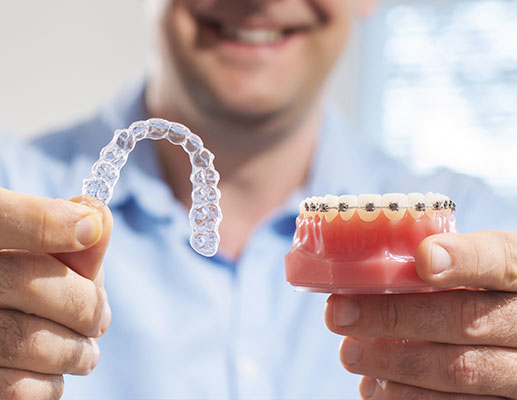
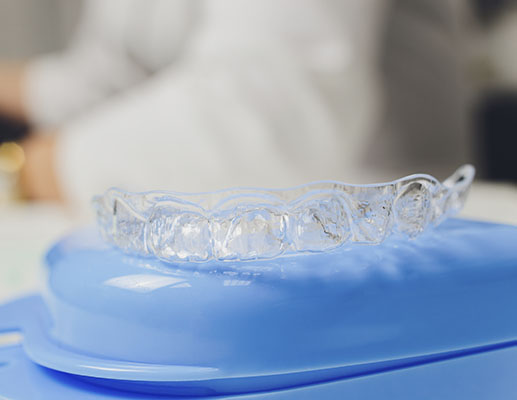
There are many options for patients who want to avoid metal braces! The most popular alternative orthodontic treatment is Invisalign®, which are clear plastic aligners designed to straighten teeth. After an examination of your teeth, your dentist will determine which option is best suited to your wants and needs.
According to the Invisalign® website, the cost for treatment is approximately the same as the cost for metal braces. A portion of this cost may be covered by your insurance. Please call us to set up a consultation and discuss potential payment plan options.
The first step is to schedule a consultation with your doctor, so they can devise a treatment plan that is best suited to your individual dental needs. Once approved, you will receive your first set of aligners. Your doctor will then regularly monitor the movement of your teeth and new aligners will be ordered according to the progress made in your treatment plan.
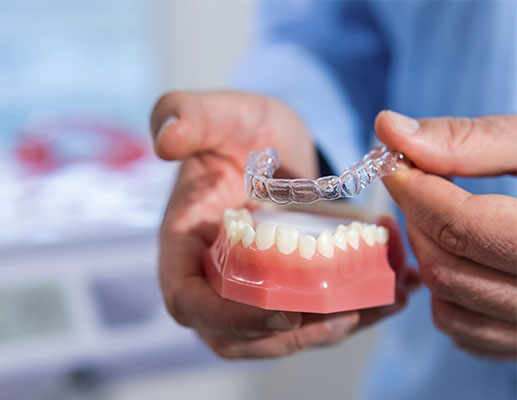
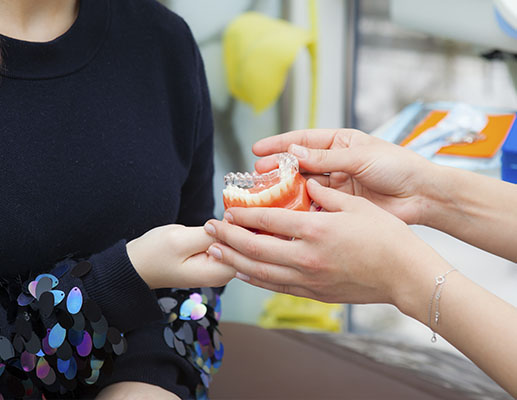
Invisalign® aligners are made of clear, flexible plastic. The company received a patent for this material – SmartTrack® – to be used exclusively for Invisalign® treatment purposes. These aligners are FDA approved and nearly invisible!
Your doctor will give you an estimate regarding how long your Invisalign® treatment should take, which will depend on your specific needs. The average length of time for treatment is approximately 12-18 months. However, some patients may see results far sooner. Remember to wear your aligners exactly as instructed by your doctor to obtain the best results.
Your doctor will most likely recommend that you wear retainers following your Invisalign® treatment. This is a precaution that will prevent your teeth from shifting back to their original positioning. It is important to follow your doctor's instructions exactly to ensure long-lasting results.
You must wear your aligners for up to 22 hours daily. You may remove them for eating, drinking and regular oral hygiene.
No. Unlike braces, you may eat whatever you like as long as you remove the aligners before eating. Prior to placing the aligners back on, it is important to brush your teeth and the aligners after you eat.
Like any orthodontic treatment, there is a short adjustment period. The more you speak with the aligners on, the quicker you will adjust.
There will be some pressure and minor discomfort for a day or two after each initial insertion. This is a sign that your teeth are moving sequentially into their final position.
It is recommended that you remove your aligners prior to chewing gum as the gum will stick to the aligners.
We discourage smoking with aligners as the cigarette smoke will tend to discolor them.
Brushing them with toothpaste will keep them fresh and clean.
Regular office visits are every five to six weeks. This will ensure that your Invisalign® treatment is progressing as planned.
All orthodontic patients are instructed to wear their retainers at night indefinitely. Sleeping with your retainers in at night will ensure a healthy bite and maintain the new position of your teeth.
Yes, if their teeth, including second molars, have grown in completely.
A baby's first teeth typically appear between 6 to 12 months of age. Usually, the two lower front teeth appear first. Baby teeth emerge from the front of the mouth and progress to the back. Most children have all their baby teeth by age three.
For babies with newly emerging teeth, we recommend using a washcloth or infant toothbrush. As your child grows and more teeth come in, use an age-appropriate soft-bristled toothbrush with a tiny dab of toothpaste. Be careful your child does not swallow the toothpaste. As your child gets older, we teach proper self-care and oral hygiene habits.
Teething is an important developmental milestone, but it can make your baby irritable. Common symptoms include fussiness, trouble sleeping, avoidance of eating, and drooling. To soothe your baby, try safe teething rings, a cold spoon, or a moist gauze rubbed over the gums. Contact our office if you have any concerns.
Baby teeth allow your child to smile, eat, and speak properly and serve as placeholders for permanent teeth. Losing a baby tooth too early can lead to misaligned teeth.
Baby teeth are just as susceptible to decay as permanent teeth. Over 50% of children develop cavities before age five. Untreated decay can affect overall health and future permanent teeth.
Baby bottle syndrome, or nursing bottle syndrome, is tooth decay caused by sleeping with a bottle containing milk or juice. It mainly affects the upper front teeth and may require extensive dental treatment. Avoid letting your baby sleep with a bottle or replace its contents with water.
Thumb or finger sucking is a common comfort habit. If it persists beyond age five or six, it may affect teeth alignment, jaw development, speech, or swallowing. Constructive guidance and, if needed, orthodontic care can help stop the habit.
The American Dental Association recommends a checkup every six months. During these visits, the dentist evaluates teeth, gums, and jaws, performs a cleaning, provides oral hygiene guidance, and addresses any emerging dental issues.
We provide gentle, compassionate care in a child-friendly environment. For anxious children, those with medical conditions, or special needs, we discuss options for care, including dental sedation, to ensure comfort and safety.
Back-to-school checkups ensure your child starts the school year healthy. Maintaining oral health helps prevent setbacks and supports a foundation for lifelong healthy dental habits.
Cavities form when plaque is not consistently removed. Poor oral hygiene and dietary habits increase risk. Fluoride treatments and dental sealants are effective preventive measures.
If a primary tooth is lost early due to decay or injury, a space maintainer can hold the space for the permanent tooth. This prevents crowding or misalignment as the permanent tooth emerges.
Orthodontic issues can often be identified by first or second grade. Our office monitors facial growth, jaw development, and smile alignment. We advise parents on the appropriate time for intervention.
Sports mouthguards are recommended for children and teens who play sports. Properly fitted mouthguards protect teeth, lips, tongue, and jaws from injury.
Dental sealants are thin, protective coatings applied to the chewing surfaces of permanent molars and premolars. They help block bacteria and acids, reducing the risk of decay.
Wisdom teeth typically emerge between ages 17 and 21. If they are impacted, misaligned, or causing problems, extraction may be necessary. We monitor their development at every checkup.